
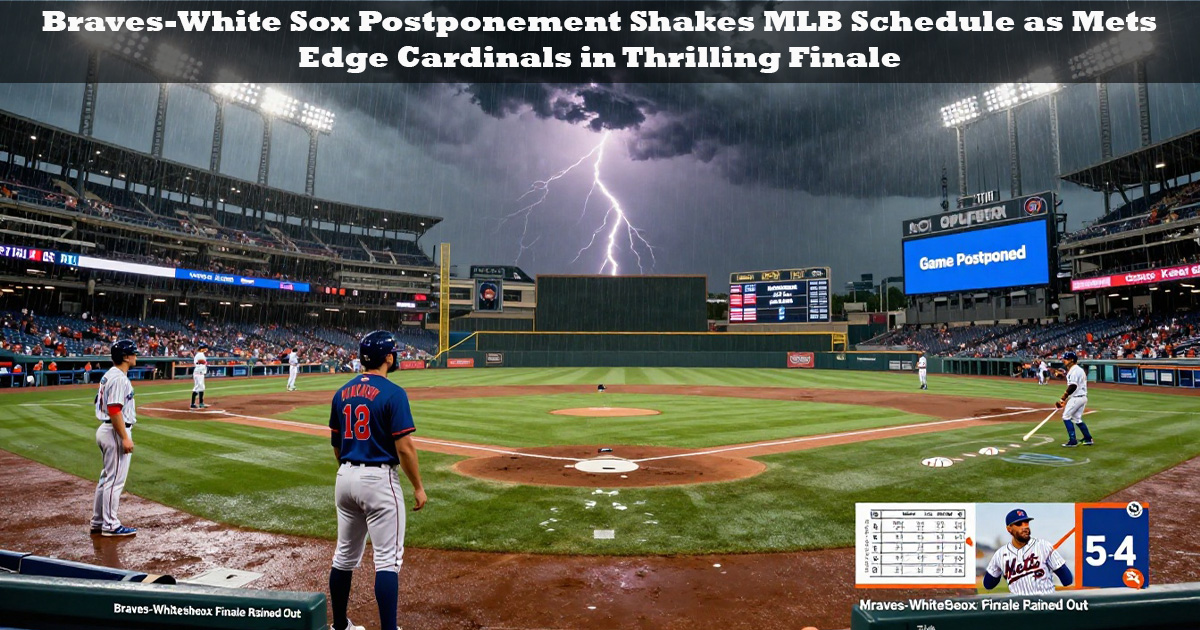
Braves White Sox Postponement became one of the biggest stories in baseball this week, creating ripple effects that extend far beyond a single canceled game.
Persistent thunderstorms in Chicago forced Thursday’s series finale between the Atlanta Braves and Chicago White Sox to be postponed at Rate Field. While weather delays are nothing new in Major League Baseball, this particular postponement arrives at a critical point in the season. Both clubs are battling for positioning in competitive divisions, and every game matters.
Meanwhile, the New York Mets earned a hard-fought 5-4 victory over the St. Louis Cardinals, splitting their brief two-game series and gaining momentum before welcoming Atlanta to Queens.
From pitching adjustments to playoff implications, here’s a closer look at what the Braves White Sox Postponement means for everyone involved.

Why the Braves White Sox Postponement Matters
At first glance, a rainout in June may seem insignificant.
However, baseball seasons are often shaped by small moments. A postponed game can alter pitching rotations, affect player rest, disrupt offensive rhythm, and even influence postseason races months later.
The Braves entered Chicago hoping to avoid a sweep. Instead, weather denied them a final opportunity to salvage a victory in the series.
For the White Sox, the postponement interrupted the momentum of a club that has quietly become one of baseball’s biggest surprises this season.
The Braves White Sox Postponement may eventually be remembered as more than just a weather story.
Braves White Sox Postponement Gives Atlanta a Rotation Advantage
One of the most immediate effects of the postponement involves Atlanta’s pitching staff.
The Braves decided to move Martín Pérez to Saturday’s matchup against the Mets. More importantly, ace Spencer Strider receives an extra day of rest before taking the mound on Friday.
That additional recovery time could prove valuable.
Strider recently threw 109 pitches in Cincinnati and has been one of Atlanta’s most important arms. Any extra rest can help maintain velocity and command throughout the long season.
Atlanta’s revised pitching schedule now looks like this:
- Friday: Spencer Strider
- Saturday: Martín Pérez
- Sunday: Bryce Elder
From a strategic standpoint, Atlanta may have quietly gained an advantage despite losing a chance to play Thursday.
Against a Mets lineup that has struggled against left-handed pitching at times, Pérez could find a favorable matchup.
How the White Sox Adjusted Their Weekend Plans
The White Sox also had to make quick decisions after the rainout.
Anthony Kay, who was originally scheduled to start Thursday’s game, remains on track to pitch Friday. Chicago will then turn to Sean Burke on Saturday and Erick Fedde on Sunday against the Los Angeles Dodgers.
The adjustment keeps the rotation stable and avoids unnecessary disruption.
Chicago’s pitching staff has been one of the team’s biggest strengths throughout June. The group has consistently delivered quality starts and helped the White Sox maintain their position atop a crowded division race.
Maintaining that rhythm will be critical as they prepare for a challenging series against the Dodgers.
Braves White Sox Postponement Ends a Potential Offensive Reset
Atlanta’s offense has not looked like its usual explosive self recently.
The Braves lost the first two games of the series by a combined three runs and struggled to capitalize on scoring opportunities. In Wednesday’s narrow defeat, they stranded 10 runners on base.
Those missed opportunities proved costly.
Thursday’s game presented a chance for Atlanta to regain confidence against a Chicago bullpen that had struggled over the previous two weeks.
Instead, the Braves were forced into an unexpected day off.
While rest can sometimes help a team regroup mentally, it can also halt momentum-building opportunities. Atlanta now enters a difficult road series against the Mets looking to avoid a fourth consecutive loss.
Hagen Smith’s Debut Remains a Major Talking Point
One of the most interesting storylines surrounding the Braves White Sox Postponement involves highly regarded pitching prospect Hagen Smith.
Earlier in the week, many observers believed Smith could make his major league debut during the weekend.
Chicago initially listed Saturday’s starter as “to be announced,” fueling speculation that the organization might call up one of its top prospects.
However, after the postponement, Sean Burke was assigned to Saturday’s game instead.
That move likely delays Smith’s debut.
Although the White Sox have not made an official announcement, the rainout removed what appeared to be the most logical opening in the rotation.
Fans will now likely wait at least another week to see when the talented left-hander receives his opportunity.

The Makeup Date Creates New Challenges
The postponed game has already been rescheduled.
Atlanta and Chicago will meet again on August 20 at 1:10 p.m. local time.
While finding a mutual off day solved the scheduling problem, it also created new complications.
For Atlanta:
- An additional travel day is inserted into an already busy schedule.
- Players lose a valuable rest opportunity.
- Road-trip logistics become more complicated.
For Chicago:
- The makeup game contributes to an exhausting stretch of consecutive games.
- Recovery time becomes more limited.
- Roster management grows increasingly important.
Late-season scheduling quirks can have a meaningful impact on playoff races.
Teams often discover that a seemingly minor June rainout becomes a significant August challenge.
What the Postponement Means for the Standings
The Braves White Sox Postponement also has standings implications.
Chicago remains at 36-31 and continues to lead a tightly packed American League Central race.
The division remains highly competitive, with multiple clubs still within striking distance.
For the White Sox, maintaining first place is particularly impressive considering where the organization stood a year ago. Their strong recent form has transformed expectations around the team.
Atlanta faces a different challenge.
The Braves are trying to keep pace in the National League East while avoiding a larger gap behind the division leaders.
Every missed opportunity matters.
Even though one postponed game may seem insignificant today, postseason races are often decided by only a few victories.
That reality makes every contest valuable.
Mets Edge Cardinals in an Entertaining Series Finale
While weather dominated headlines in Chicago, the Mets quietly secured an important victory over St. Louis.
New York defeated the Cardinals 5-4 in a tightly contested game.
The turning point came during a three-run fifth inning that shifted momentum in the Mets’ favor.
A key extra-base hit helped break the tie and energized the home crowd.
The Cardinals fought back late, but New York’s bullpen ultimately protected the lead.
Closer Edwin Díaz delivered another strong performance, recording his 17th save of the season.
The victory allowed the Mets to split the two-game series and continue building confidence at home.
That momentum could become important as Atlanta arrives in town.
Why the Mets-Braves Series Suddenly Feels Bigger
The upcoming Braves-Mets matchup now carries additional intrigue.
Several factors contribute to the excitement:
Extra Rest for Spencer Strider
The Braves’ ace enters the series with fresh legs and additional preparation time.
Mets Playing Confident Baseball
New York has enjoyed strong recent results at home and appears to be finding consistency.
Divisional Implications
Every game between division rivals matters, especially when standings are tightly contested.
Momentum Battle
The Mets enter with a win.
The Braves arrive after three consecutive losses.
Those contrasting trends add another layer of drama.
Looking Ahead
Baseball seasons are long, and unexpected events often shape the journey.
The Braves White Sox Postponement serves as another reminder that success requires flexibility. Teams must adapt to weather, injuries, travel changes, and scheduling adjustments while maintaining focus on the bigger picture.
For Atlanta, the immediate goal is simple: stop the losing streak and regain offensive momentum against New York.
For Chicago, the challenge is continuing its impressive rise in the AL Central while managing a busy schedule.
Both teams remain firmly in the playoff conversation.
That means every decision, every start, and every game carries significance.