
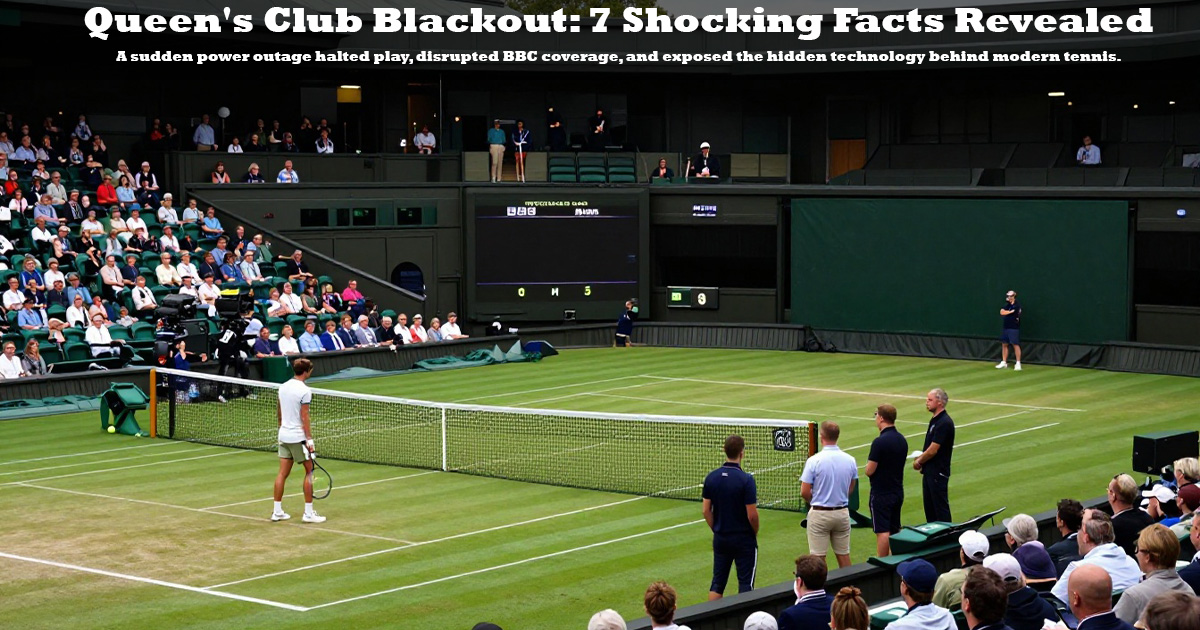
Queen’s Club blackout became one of the most talked-about moments of the tennis season, not because of a thrilling rally or a championship upset, but because everything suddenly stopped.
Fans gathered at London’s prestigious Queen’s Club expecting a day of world-class grass-court tennis. Instead, they witnessed an unusual scene: electronic systems failed, giant screens went dark, line-calling technology stopped working, and even the BBC’s live coverage was temporarily interrupted.
For nearly an hour, one of Britain’s most respected sporting events found itself dealing with a challenge that modern tennis rarely faces—a complete loss of power.
The incident reminded everyone how deeply today’s sporting events depend on technology and how quickly a single technical failure can disrupt players, broadcasters, and thousands of spectators.

What Happened During the Queen’s Club Blackout?
The Queen’s Club blackout occurred during the afternoon session of the cinch Championships in London.
Without warning, several key systems shut down simultaneously. Electronic line-calling stopped functioning, public-address announcements were interrupted, replay screens went blank, and tournament officials suddenly lost access to crucial match technology.
Play was halted as officials attempted to determine how to proceed safely and fairly.
Players stood near the court waiting for updates while spectators looked around in confusion. Since electronic systems play a major role in modern tennis officiating, continuing the match immediately was not an option.
As minutes passed, the disruption grew more noticeable, turning a routine tournament afternoon into an unexpected headline.
Why Modern Tennis Depends on Technology
Many fans think of tennis as a simple game involving rackets, balls, and players. However, today’s professional tournaments rely heavily on advanced technology.
Electronic Line Calling
Modern events increasingly use automated line-calling systems instead of traditional line judges.
These systems help determine whether a ball lands in or out with remarkable accuracy.
When power failed during the Queen’s Club blackout, officials temporarily lost access to one of the most important decision-making tools in the sport.
Hawk-Eye Replays
Replay systems allow players, officials, broadcasters, and fans to review important moments from multiple angles.
Without power, these systems became unavailable, making it difficult to verify certain situations during play.
Communication Networks
Tournament operations depend on communication systems connecting officials, security teams, broadcasters, and technical staff.
When those systems are disrupted, managing a large sporting event becomes significantly more complicated.
The BBC’s Unexpected Broadcast Challenge
One of the most fascinating aspects of the Queen’s Club blackout was its impact on television coverage.
The BBC is known for delivering smooth and professional sports broadcasts. Whether covering Wimbledon, the Olympics, or major national events, viewers rarely notice the extensive technical infrastructure operating behind the scenes.
During the outage, however, that infrastructure was affected.
Commentary feeds were interrupted, technical connections became unstable, and viewers suddenly found themselves without the normal flow of live coverage.
Presenter Clare Balding informed audiences that a technical issue had occurred beyond the broadcaster’s control.
Although the interruption was relatively short, it offered a rare glimpse into the challenges broadcasters face when unexpected technical failures occur.
Even the most experienced television teams cannot broadcast a live sporting event when the essential power systems stop working.
The Impact on Players and Spectators
Players Lost Their Rhythm
Athletes carefully prepare for competition.
Warm-ups, mental routines, and momentum all play a role in performance.
A sudden interruption can change the dynamic of a match entirely.
Some players used the delay to stretch and stay active. Others practiced lightly to maintain focus. Regardless of preparation, an unexpected stoppage creates uncertainty.
A player building momentum may lose it during a lengthy delay, while a struggling opponent may benefit from the break.

Fans Faced an Unusual Silence
Spectators experienced something equally unusual.
Large sporting events are filled with announcements, crowd noise, replay screens, and constant activity.
When those systems disappeared during the Queen’s Club blackout, the atmosphere changed dramatically.
Instead of the usual buzz of championship tennis, many fans found themselves sitting in near silence, checking their phones for updates and wondering when play would resume.
It was a rare reminder of how much technology shapes the modern spectator experience.
The Race to Restore Power
As the outage continued, tournament staff worked urgently to identify the problem and restore essential services.
Engineers and operations teams coordinated efforts behind the scenes while organizers attempted to minimize disruption.
Eventually, backup generators began supplying power to critical systems.
Screens flickered back to life.
Communication networks gradually returned.
Electronic line-calling systems restarted.
One by one, the tournament’s essential functions resumed.
Although the recovery process took time, organizers managed to avoid a much longer shutdown and successfully returned the event to its schedule.
Why the Incident Raised Bigger Questions
The Queen’s Club blackout sparked discussion far beyond a single afternoon of tennis.
Many observers began asking important questions:
- What exactly caused the outage?
- Were backup systems fully prepared?
- Could critical services have been restored faster?
- How vulnerable are major sporting events to technical failures?
Modern tournaments rely on extensive electrical and digital infrastructure.
While technology improves accuracy and fan engagement, it also creates new points of vulnerability.
When power fails, multiple systems can stop functioning at once.
That reality became impossible to ignore during the incident.
Could It Happen Again?
Power disruptions at major sporting events are uncommon, but they are not impossible.
Weather conditions, equipment failures, damaged cables, or issues within local electrical networks can all create unexpected problems.
Most venues invest heavily in backup generators and contingency planning.
However, no system is completely immune to failure.
The lessons learned from the Queen’s Club blackout may encourage event organizers around the world to review emergency procedures and strengthen resilience measures.
As sports become increasingly technology-driven, reliable backup systems will remain essential.

Lessons for Future Sporting Events
The outage highlighted several important lessons for sports organizations.
Invest in Redundant Systems
Critical services should have multiple layers of backup protection.
Regular Emergency Testing
Backup generators and technical systems should be tested under realistic conditions.
Clear Communication Matters
Spectators and television audiences appreciate timely updates during disruptions.
Technology Requires Contingency Plans
As events become more digital, organizers must prepare for situations where technology suddenly becomes unavailable.
These lessons extend far beyond tennis and apply to stadiums, arenas, and sporting events worldwide.