
Why This Game Is Closer Than It Looks
The Narrative vs. The Reality of This Matchup
When two powerhouse programs collide on a national stage, the conversation usually revolves around stars, rankings, and stat sheets. But as we saw in the Miami vs Ohio State College Football Playoff quarterfinal at the Cotton Bowl, big games are rarely decided by the obvious. While the world was watching the Heisman highlights, a 24–14 shocker was being brewed in the margins.
The truth is, this clash between the No. 10 Hurricanes and the No. 2 Buckeyes wasn’t just a win for. “The U”—it was a clinic on how “hidden” variables can dismantle a defending national champion. If you look at the final box score, you see the score. If you look closer, you see the six X-factors that turned the 2026 Cotton Bowl into a nightmare for the Buckeyes.
1. Trench Warfare: The Rueben Bain Jr. Effect
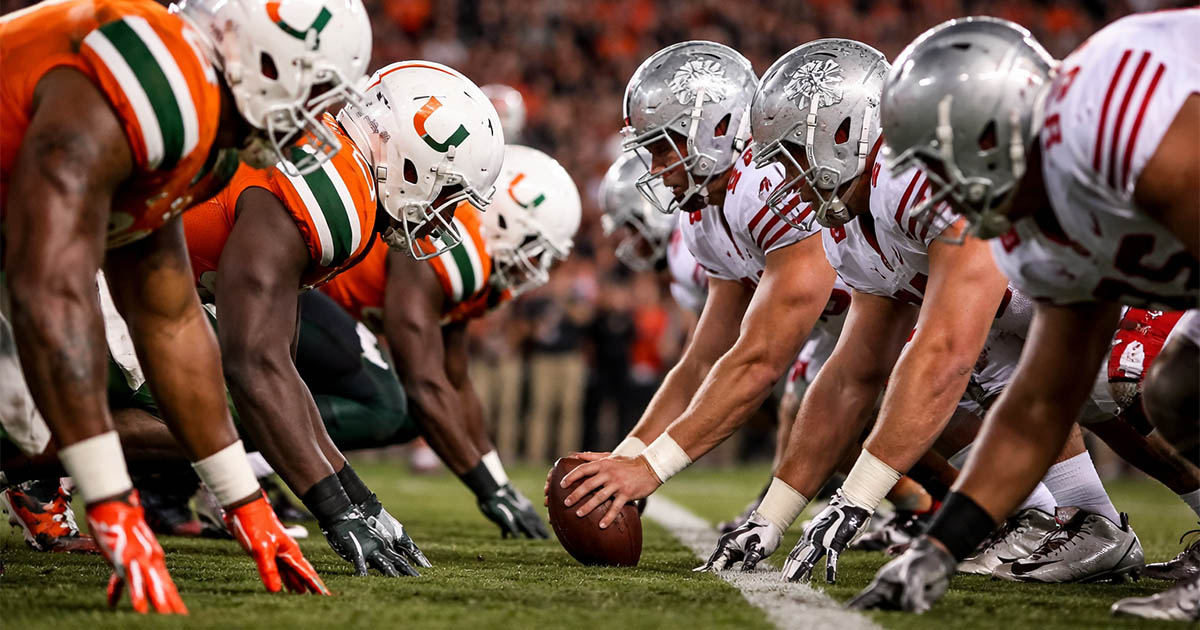
Every football game begins at the line of scrimmage, but in the Miami vs Ohio State matchup, the trenches took on a surgical significance. On paper, Ohio State’s offensive line was a veteran unit designed to protect Julian Sayin. In reality, they met a “Green Wave” led by Rueben Bain Jr. and Akheem Mesidor.
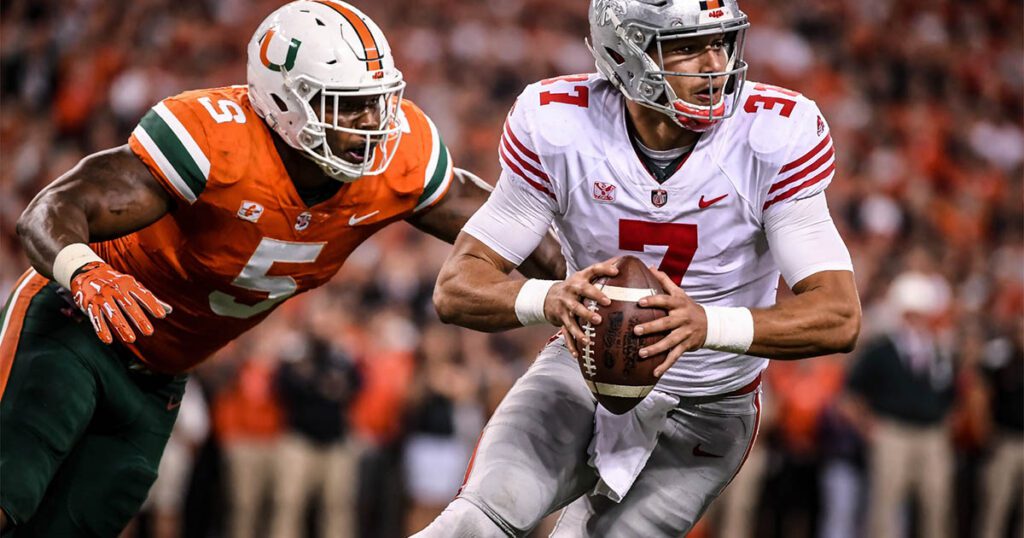
Miami’s defense thrives on controlled aggression, and in this game. They exploited a critical lack of lateral quickness in the Buckeyes’ interior. While analysts focused on Ohio State’s explosive receivers, the real story was Bain’s relentless motor. By sacking Sayin five times—nearly matching his total for the entire regular season. Miami forced the Buckeyes into a “shrink the playbook” mode.
The hidden X-factor here wasn’t just the sacks; it was the disruption of timing. Ohio State’s passing game is built on rhythm. When Bain collapsed the pocket in under 2.5 seconds, that rhythm died. For anyone analyzing Miami vs Ohio State. It’s clear: the Hurricanes didn’t just win the line; they dictated the tempo of the entire evening through sheer physical imposition.
2. Quarterback Poise: The Tale of Two Champions
Statistics rarely capture emotional weight, but they certainly showed the difference in composure during Miami vs Ohio State. Both Carson Beck and Julian Sayin entered with championship rings, but only one looked comfortable under the AT&T Stadium lights.
Carson Beck was the embodiment of efficiency. He didn’t need to throw for 400 yards; he needed to be “boring.”
By setting a Cotton Bowl record with 13 consecutive completions, Beck kept the chains moving and the Buckeyes’ defense on the field. On the other side, the pressure clearly “sped up” Sayin.
The turning point was the 72-yard pick-six by Keionte Scott. It was a classic “big-game pressure” mistake—a quick screen pass that Scott jumped because he knew Sayin was looking for a “safe” throw under duress.
In the high-stakes environment of Miami vs Ohio State, Beck’s willingness to take the check-down to Mark Fletcher Jr. was the quietest, most effective weapon on the field.
3. The “Bye Week” Curse and Coaching Adjustments
The narrative around marquee college football games often suggests that a first-round bye is an advantage.
However, the Miami vs Ohio State result adds to a staggering trend: teams with a bye are now 0–5 in the expanded playoff era.
While Mario Cristobal had his team “battle-tested” from a gritty win over Texas A&M just days prior, Ryan Day’s Buckeyes looked rusty.
The coaching X-factor showed up in the first half: Ohio State failed to score a single point for the first time in nine years.
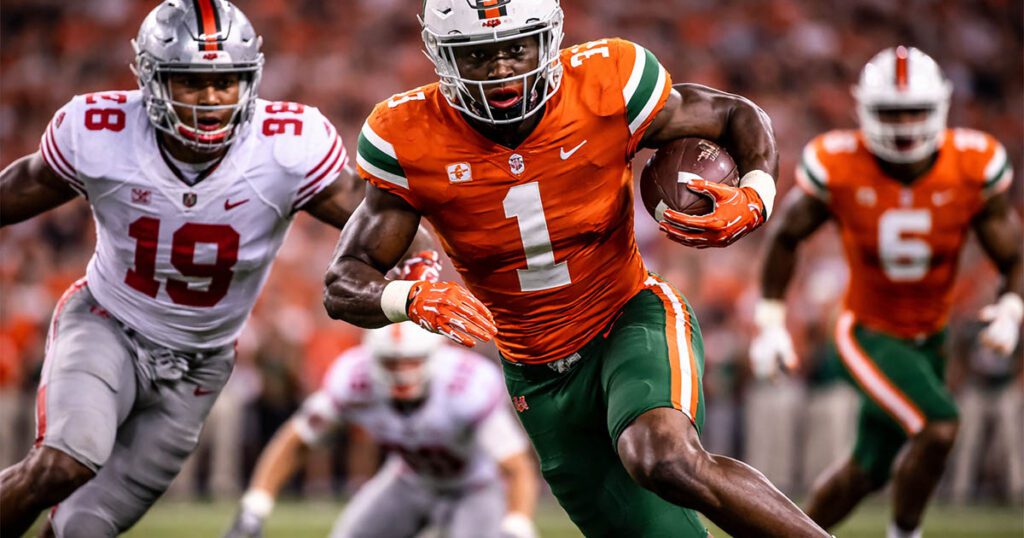
Cristobal and offensive coordinator Shannon Dawson used a “jumbo” package and a heavy dose of Mark Fletcher Jr. to keep the Buckeyes’ defense guessing. Meanwhile, Ohio State struggled to adapt to Miami’s late-movement fronts.
It wasn’t until the fourth quarter that the Buckeyes found a rhythm with Jeremiah Smith, but by then, the “psychological edge” had already shifted firmly to the Miami sideline.
4. Special Teams and Hidden Yardage
Special teams rarely dominate headlines, but they were the secret sauce in Miami vs Ohio State. Field position is strategy disguised as distance, and Miami won that battle handily.
Carter Davis’s 49-yard field goal in the third quarter might have seemed like a “consolation” at the time, but it pushed the lead to 17–7, forcing Ohio State to play two-possession football. Furthermore, the Hurricanes’ punting unit consistently pinned the Buckeyes deep, preventing Julian Sayin from working with a short field.
In a game where the margin of error was razor-thin, the ability of Miami to execute on the “boring” plays—kick coverage, reliable snapping, and safe returns. Prevented Ohio State from ever gaining the “shockwave” momentum they needed to mount a full comeback.
5. Depth and Fourth-Quarter Conditioning
Championship-level games are survived through the fourth quarter, and this is where Miami’s “rotation discipline” paid off. Throughout the Miami vs Ohio State contest, Cristobal rotated his defensive line heavily, keeping Bain and Mesidor fresh for the final drive.
This was evident when Ohio State pulled within three points (17–14). Many expected the Hurricanes to fold under the pressure of a defending champ. Instead, Miami went on a surgical 10-play, 70-yard drive that ate over five minutes of clock.
CharMar Brown, the sophomore back, became the unsung hero, converted key third downs against a gassed Buckeyes’ front seven. This drive, capped by Brown’s 5-yard touchdown, was the definitive proof of Miami’s superior conditioning. They didn’t just play better; they had more “gas in the tank” when it mattered most in the Miami vs Ohio State finale.
6. The Psychological “U” Factor
Neutral-site atmospheres are unpredictable, but the “U” traveled in force to Arlington. The presence of legends like Ray Lewis and Michael Irvin on the sidelines isn’t just for show—it creates an emotional current.
In the Miami vs Ohio State matchup, the Hurricanes played with the “nothing to lose” swagger of a No. 10 seed, while Ohio State played with the “weight of the world” as the defending champs.
You could see it in the body language: Miami celebrated every tackle, while Ohio State looked frustrated by every holding call.
When Jakobe Thomas intercepted Sayin in the final minute, it wasn’t just a turnover; it was the exorcism of two decades of postseason frustration. For Miami, this wasn’t just a game; it was a statement that the hierarchy of college football has officially shifted.
By the time the final whistle blew, the Miami vs Ohio State score showed a 10-point margin. But the game felt like it was won in a thousand tiny moments. It was won in the film room, where Keionte Scott studied Sayin’s screen tendencies. It was also won in the weight room, where Rueben Bain Jr. prepared to bull-rush NFL-caliber tackles.
The 2026 Cotton Bowl will be remembered as the night the Hurricanes officially returned to the national elite. It serves as a reminder that in a Miami vs Ohio State battle, talent is the baseline, but the. Hidden details—the poise, the conditioning, and the trenches—are what ultimately build a champion.
Also read for more information : Miami beats defending national champ Ohio State 24-14 in the CFP quarterfinal at Cotton Bowl
Read next on Dribkick : New Mexico vs Minnesota: 9 Lessons From the Gophers’ Dramatic OT Bowl Win
Hawaii vs California Highlights: 6 Game-Changing Moments in a Stunning Finish